April 23, 2026
4:00-5:30pm BST
A Roundtable on Tibetan Culture, Human Rights and Exile will be held at St. Andrews University, Scotland, UK, on April 23, sponsored in part by Tibet House US (thanks to David and Tara Phillips). The event is free and open to the public.
Event link: https://www.facebook.com/share/1JAmdNTvGf/?mibextid=wwXIfr
Please see Mr. Phillips’s presentation herein:
Roundtable on Tibetan Culture, Human Rights and Exile
Remarks by
David L. Phillips[1]
St. Andrews University
April 23, 2026
Good afternoon. I am grateful to St. Andrew’s University for hosting today’s conference and Tibet House US for sponsoring. I am especially grateful to my daughter, Tara Phillips, a third year at St. Andrew’s, for leading this initiative.
Tibetan Culture
Religion is central to Tibetan culture. Tibetan culture is rooted in Tibetan Buddhism, a form of Mahayana and Vajrayana teaching that integrates meditation, ritual, and philosophy to study and achieve enlightenment. Bon is an indigenous shamanistic tradition that predated Buddhism and influenced its Tibetan form. Tibetan Buddhism was introduced from India in the 7th century and became the dominant religion in Tibet shaping art, literature, music and social life.
Tibetan Buddhism rejects aggression and offers a path to inner peace by recognizing the fundamental connection between all sentient beings. It emphasizes compassion, wisdom and meditation techniques designed to advance enlightenment. Monasteries served as centers for learning, governance, and cultural preservation. At its core, Tibetan Buddhism is pluralist and democratic.
Tibet was divided into three cultural provinces called U-Tsang, Kham and Amdo. Each one developed its own distinct dialect of the Tibetan language. Most widely spoken is the Lhasa dialect, Standard Tibetan. Tibetan music often involves chanting in Tibetan or Sanskrit as an integral part of religious practice. These chants are complex recitations of sacred texts and celebrations of various festivals.
In 1912, following the fall of the Qing Dynasty, Tibet became de facto independent under the 13th Dalai Lama. He resided in the Potala Palace in Lhasa high in the Himalayas at the rooftop of the world. Tibet’s physical isolation allowed the religion to develop free from outside interference.
This ended with China’s civil war; Tibet was invaded and annexed by China in 1950. Mao Tse Tung condemned Tibet as a serf society, accused the Dalai Lama of being undemocratic, and initiated a period of repression. In 1959, the 14th Dalai Lama fled the country with a group of devoted followers and settled in India. His dramatic escape is recounted in the book by John Avedon, Exile from the Land of Snows.
During the Cultural Revolution (1966–76), religion was one of the main political targets of the Chinese Communist Party. Several thousand temples and monasteries in Tibet were destroyed and their bricks used to build army barracks. Many monks and lamas were imprisoned. Tibetan cultural traditions were suppressed. Texts, cultural heritage and institutions were destroyed.
The Chinese government still retains strict control over Tibetan Buddhist Institutions. Quotas on the number of monks and nuns are maintained, and their activities are closely supervised. Many monasteries have been destroyed, forced reeducation is widespread, young monks are required to relinquish their robes, and nuns are detained and violated.
Teachings
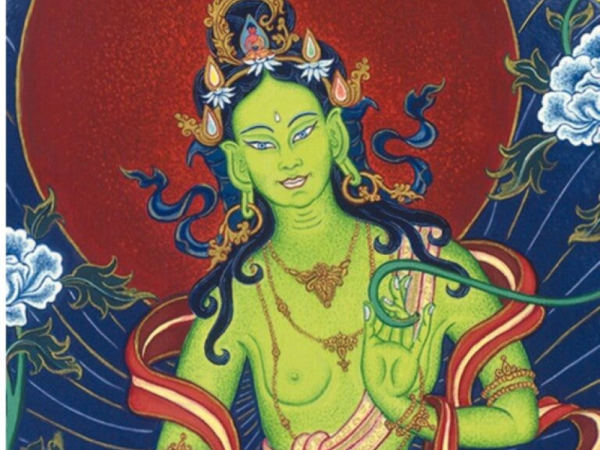
Tibetan Buddhism upholds classic Buddhist teachings such as the four noble truths, karma, and rebirth. It upholds other Buddhist doctrines associated with Mahāyāna Buddhism, as well as the tantric Vajrayana tradition. The Mahāyāna goal of spiritual development is to achieve the Buddhahood in order to help all other sentient beings attain this state. This motivation is called “bodhicitta”, (mind awakening)—an altruistic intention to become enlightened for the sake of others. Widely revered Bodhisattvas include Avolikateshva, Manjushri, Vajrapani and Tara (the namesake of my daughter)
The Bodhisattva has achieved a continuous bliss and an understanding of emptiness (Sunyata), as the true nature of reality. Tibetan Buddhism teaches a fast track to Buddhahood (known as the Vajrayana path). Among the most widely studied texts in Tibetan Buddhism are Mahayana sutras such as the Perfection of Wisdom. The practice of compassion (Karuna) is particularly important in Tibetan Buddhism. Tibetan Buddhist practitioners repeat mantras like “Om Mani Padme Hum” in order to train the mind and transform their thoughts. Mantras also serve to focus and calm the mind by recognizing the inseparability between our own well-being and happiness of others. This recognition inspires us to promote freedom and justice for ourselves and others equally.
The Four Noble Truths Doctrine considers the origination of suffering and ways to control it. The first noble truth is that suffering originates from attachment. The second noble truth considers the cause of suffering, which derives from craving, attachment and ignorance. Further, craving and ignorance give rise to mental defilements such as greed, anger, and delusion. Our basic misunderstanding of reality and or lack of self-awareness cause suffering. The third noble truth affirms that a human being will be inspired to overcome suffering by knowing its root cause. The fourth noble truth proposes the way to address suffering and achieve mental well-being and serenity, which is generally called the noble eightfold path. It includes right view, right thought, right speech, right action, right livelihood, right effort, right mindfulness, and right concentration.
Zone of Peace
Politics and conflict have intruded on Tibet’s serenity, requiring the Dalai Lama to be a spokesman for his people. Addressing the U.S. Congressional Human Rights Caucus on September 21, 1987, he said: “The world is increasingly interdependent, so that lasting peace – national, regional and global – can only be achieved if we think in terms of broader interest rather than parochial needs. I speak to you today as the leader of the Tibetan people and as a Buddhist monk devoted to the principles of a religion based on love and compassion. Above all, I am here as a human being who is destined to share this planet with you and all others as brothers and sisters.”
He continued, “Tibetans are a peace loving and non-violent people. Since Buddhism was introduced to Tibet over one thousand years ago, Tibetans have practiced non-violence with respect to all forms of life. The Chinese authorities have attempted to confuse the issue by claiming that Tibet has always been a part of China. This is untrue. Tibet was a fully independent state when the People’s Liberation Army invaded the country in 1949/50.
It is my sincere desire, as well as that of the Tibetan people, to restore to Tibet her invaluable role, by converting the entire country – comprising the three provinces of U-Tsang, Kham and Amdo – once more into a place of stability, peace and harmony. In the best Buddhist tradition, Tibet would extend its services and hospitality to all who further the cause of world peace and the well-being of mankind and the natural environment we share.”
His peace plan contains five basic components:
– Transformation of the whole of Tibet, U-Tsang, Kaham and Amdo, into a zone of peace.[2]
– Abandonment of China’s population transfer policy which threatens the very existence of the Tibetans as a people;[3]
– Respect for the Tibetan people’s fundamental human rights and democratic freedoms;[4]
– Restoration and protection of Tibet’s natural environment and the abandonment of China’s use of Tibet for the production of nuclear weapons and dumping of nuclear waste;[5]
– Earnest negotiations on the future status of Tibet and of relations between the Tibetan and Chinese peoples.[6]
I participated in the dialogue and held meetings with the CPC’s United Front. I concluded that Chinese officials were not sincere about a genuine Modus Vivendi. They were motivated by domination and subjugation.
The Dalai Lama received the Nobel Prize for Peace in 1989. The Nobel Committee acted in recognition of his peace philosophy, reverence for all living things, and the idea of a universal responsibility that embraces both man and nature. It recognized His Holiness “for advocating peaceful solutions based upon tolerance and mutual respect in order to preserve the historical and cultural heritage of his people”
The Dalai Lama’s goals have not been realized. Tibetans chafe under China’s rule. Since 2009, 141 Tibetans have engaged in self-immolation, setting their bodies alight, in protest against China’s heavy-handed rule. No formal negotiations between People’s Republic of China (PRC) officials and the Dalai Lama or his representatives have occurred since 2010.
There is a silver lining to Tibet’s tragedy. The Dalai Lama’s exile was a gift for humanity because it exposed the global community to his teachings, which are an antidote to aggression, anger and ignorance. Tibetan culture survives in exile. We can create a zone of peace within our hearts, families, and communities. The essence of Tibetan culture is building a better world.
[1] David L. Phillips, a former US official, is a Visiting Academic at St. Antony’s College, Oxford University.
[2] “Ahimsa” is a Hindi term used to mean a state of peace and non-violence.[2]
[3] In the Amdo province, there are, according to the Chinese statistics, 2.5 million Chinese and only 750,000 Tibetans. Even in the so-called Tibet Autonomous Region (i.e., central and western Tibet), Chinese government sources now confirm that Chinese outnumber Tibetans. Today, in the whole of Tibet 7.5 million Chinese settlers have already been sent, outnumbering the Tibetan population of 6 million. In central and western Tibet, now referred to by the Chinese as the “Tibet Autonomous Region”, Chinese sources admit the 1.9 million Tibetans already constitute a minority of the region’s population. These numbers do not take the estimated 300,000-500,000 troops in Tibet into account – 250,000 of them in so-called Tibet Autonomous Region.
[4] Discrimination is practiced in Tibet under a policy of “apartheid” which the Chinese call “segregation and assimilation”. Tibetans are second class citizens in their own country. Deprived of all basic democratic rights and freedoms, they exist under a colonial administration in which all real power is wielded by Chinese officials of the Communist Party and the army.
[5] Tibetans have a great respect for all forms of life. This inherent feeling is enhanced by the Buddhist faith, which prohibits the harming of all sentient beings, whether human or animal. Prior to the Chinese invasion, Tibet was an unspoiled wilderness sanctuary in a unique natural environment. Wildlife and the forests of Tibet have been almost totally destroyed by the Chinese.
[6] The dialogue was supposed to focus on meaningful autonomy for Tibetans within the PRC, ongoing abuses of the human rights of Tibetans in the PRC, and efforts by PRC authorities to eliminate the distinct religious, linguistic, and cultural identity of Tibetans.